Carbon Matters 8 – Rosslyn Air Source Heat Pumps

As part of our Carbon Matters series, we want to share some of the work we have been doing on complex, significant historic buildings to make them net zero ready. Surrounded by the ancient woodland of Roslin Glen, Rosslyn Castle clings to the rock above the River Esk. The Castle, which dates to the early 16th century, is the ancestral home of the St Clair family and today is run by The Landmark Trust as a holiday rental property. The occupied castle is Category A listed and sits within the scheduled monument of the broader castle complex. The main part of our project was the re-roofing of the Great Hall and Tower (previously a ruin) to create a kitchen and living area, alongside an additional bedroom and WC. However, our client had issues with the castle being cold and draughty with poor hot water supply. This created the opportunity to re-consider the heating and hot water system for the whole castle, as well as a series of fabric upgrades to reduce energy demand and create a more energy efficient, comfortable internal environment.
The castle was previously heated by electric storage heaters, which were inefficient and at odds with the historic fabric. Alongside our services engineers, Harley Haddow, we considered a number of heat pump solutions. Keeping an electric heating solution, means that in time the client can connect to a renewable energy supply, and ultimately become net zero.
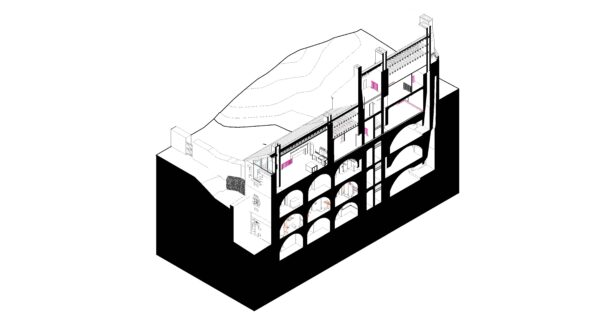
Ground source heat pumps were ruled out given the constraints of the ancient woodland and scheduled monument. Water source connecting to the River Esk was also considered, but again significant disruption within the ancient glen was not viable. The most viable option was air source heat pumps (ASHP), but there were two significant barriers 1) the temperature in the glen regularly drops to -10 degrees and below in winter, and ASHPs are not as efficient below -5 degrees and, 2) the listing of the building combined with the scheduled monument meant externally mounted ASHPs were inappropriate and unlikely to gain consent. The solution was to locate the ASHPs within the castle’s vaults.
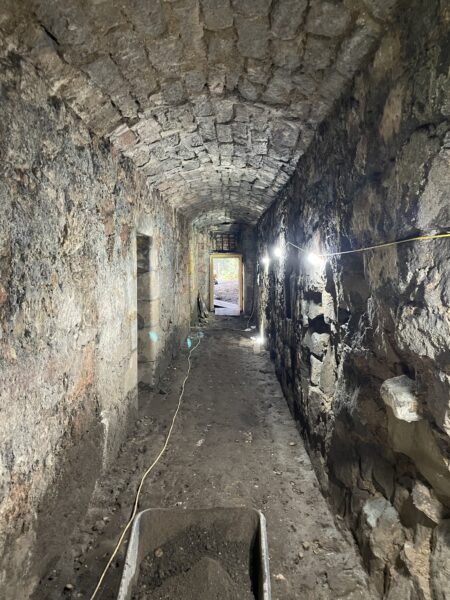
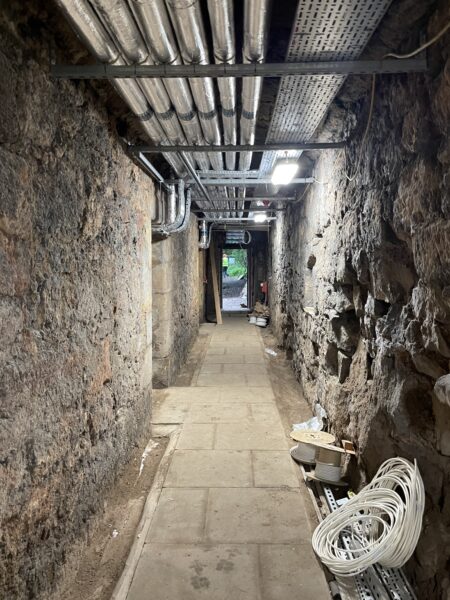
The castle sits atop three storeys of semi-external stone vaults. Historically these were service spaces; a bakehouse, kitchens, and dungeon. All levels are connected via original openings in the floors of the castle which previously would have been used to bring goods up and down between the service spaces and serviced rooms of the castle. We reimagined these vaults as a new services area for the castle’s low carbon future, using the original holes in the floor to get equipment and materials in. By locating the ASHPs in the vaults and using the thermal mass of the stone vaults to maintain a temperature of approx. 10 degrees, meant the low carbon systems would work efficiently all year round. The vaults, with walls up to 1.5m thick, had been left exposed to the weather for centuries leading to significant decay of the stonework. Fans, discretely located within existing window openings, maintain steady air movement around the vaults to ensure the constant temperature for the ASHPs, but also speed up the drying process of the historic stonework and support long term moisture management within these semi-external spaces. The old and new technologies work together, in a symbiotic relationship.
Acoustics were carefully considered. The fans are fitted with bespoke silencers, tested and adjusted on site with an acoustician, to ensure the peaceful quality of the Glen was maintained.
The balance between preserving heritage and reducing energy consumption is a tricky one. However, by embracing and working with the characteristics of the castle, we have developed an appropriate and efficient solution. Combined with fabric upgrades including insulation, new windows and draught sealing, the low carbon heating and hot water system make this ancient castle net zero ready.
M&E Engineer – Harley Haddow
Mechanical sub – Lothian Heating Services
Electrical – PFMS Facilities (Electrical Division)